

Interview with IHK Research Award winner and doctoral candidate Anjali Wankhede
When Anjali Wankhede left the metropolis of Nagpur in India, with its 2.4 million inhabitants, almost four years ago to study at Harz University of Applied Sciences in Wernigerode, she had no idea how much this decision would advance her career. Not only did she complete her master's degree in Technology and Innovation Management, but her master's thesis also won her the IHK Research Award 2025, along with prize money of €2,000. She is currently pursuing her doctorate in Wernigerode and is a scholarship holder at the International Graduate Academy (InterGrad-EGD), a joint project of the universities of Harz, Anhalt, Magdeburg-Stendal, and Merseburg. In this interview, the 28-year-old reveals why she considers her move to Germany to be the best decision of her life, how she wants to contribute to the energy transition and climate protection with her research, what ambitious plans she has for the future, and what advice she gives to young people who are unsure about their life plans.
You came to Germany in April 2022. How do you feel now about your decision to leave your home country of India?
At the time, I was a little afraid of starting over, as I had a steady job at a pharmaceutical company in India. But I dared to take the risk and discover what lies outside Asia. I still hold the boarding pass of the flight as I think it was the best decision of my life.
How are you finding your new life in a country that is so different from your homeland?
India is culturally very diverse, so there are many significant differences. But experiencing these different ways of life for myself has really helped me to broaden my thinking and my perspective. I think I've even become quite Germanized now. (laughs) I'm slowly getting used to the cold, and I really enjoy having coffee and cake with my German friends at 4 p.m. I also really appreciate that women are treated equally to men here, especially in academia. It's nice to see that there are many female CEOs and deans here. I also really appreciate the honesty and straightforwardness of Germans in general, because I think honest feedback is great. Of course, I miss my family, especially my mother, who I am very close to. But as they say in German: Es ist, wie es ist.
You have completed the English-language master's program in Technology and Innovation Management at Harz University of Applied Sciences. What insights did you gain during this time?
I took a variety of courses, ranging from IT-related topics to sustainability and some aspects of project management. I probably learned the most in the area of sustainability, as its definition in Germany is very different from that in India. I think sustainability has become a way of life here, as it started a long time ago. In my opinion, Germany can be a good role model for many countries, especially India.
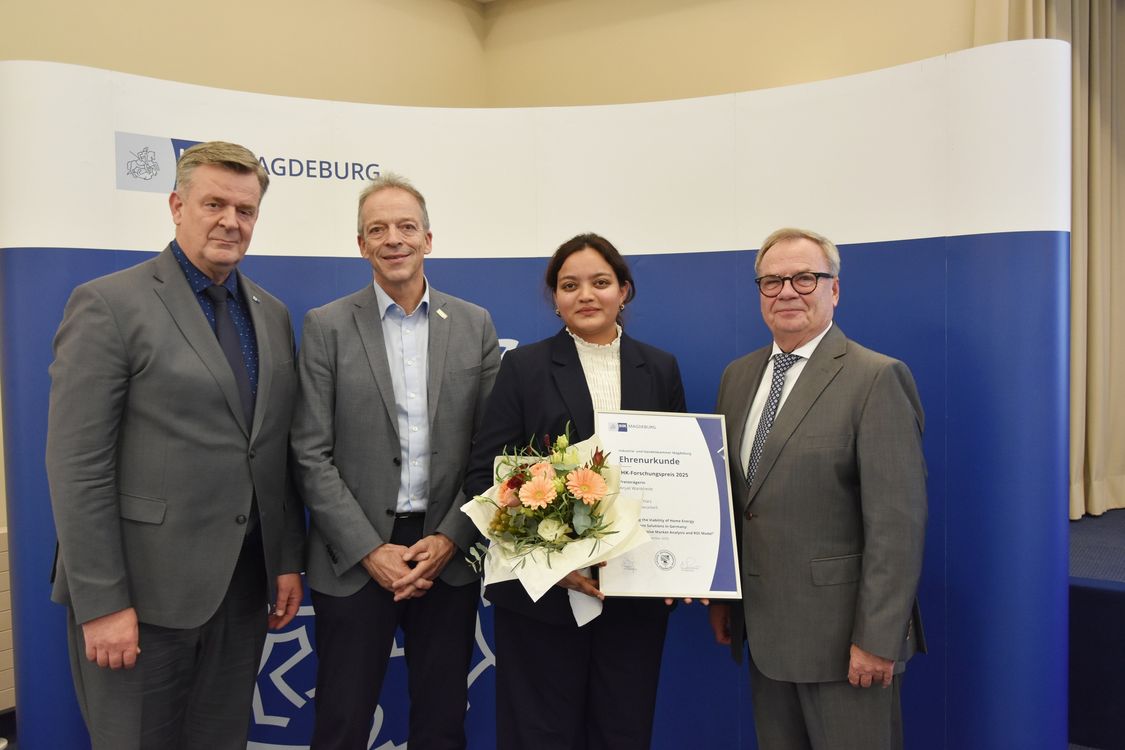
In your master's thesis, which won you the 2025 IHK Research Award, you deal with solutions for energy management in private households in Germany. How can your work contribute to sustainable energy supply?
Technologies such as photovoltaics and battery storage are already known to reduce energy consumption and lower electricity costs. My work helps to provide a deeper understanding of how these technologies can be intelligently controlled and integrated into everyday life so that they truly serve people and not the other way around. It shows how households can achieve higher self-consumption, reduce grid load, and lower CO₂ emissions through the intelligent control of PV systems, batteries, and flexible loads. On a personal level, this work has been my way of bringing the energy transition into households—into the everyday lives of families, tenants, and homeowners. If my work contributes even a small step toward making sustainable energy more accessible, intuitive, and people-centered, then it has achieved exactly what I had hoped for.
What was your personal motivation for focusing on a topic related to future energy and sustainability?
When I started my thesis in December 2023, the effects of the global energy crisis triggered by Russia's invasion of Ukraine were still being felt. The sharp rise in electricity prices made the energy crisis very real for many people around me for the first time. Seeing how something as basic as electricity can become a source of anxiety in winter motivated me to work on concrete solutions that help households use energy more intelligently, reduce costs, and still support the energy transition. At the same time, the climate crisis has made me realize that sustainability is not just an academic topic, but a personal responsibility of our generation. I was particularly moved by the words of British polar explorer and environmentalist Robert Swan: “The greatest threat to our planet is the belief that someone else will save it.” For me, that is exactly why I chose this topic.
You are currently a doctoral student at the Doctoral Center for Engineering Sciences and Information Technologies (IWIT). What motivated you to pursue this path and aim for a doctoral degree?
My doctoral studies at IWIT are closely linked to my upbringing and what I learned about myself during my studies. My mother always taught me that education is a privilege, as she herself never had access to such opportunities, and I took that to heart. During my first extensive project work, I became intensively acquainted with working on research topics and realized that this kind of structured curiosity and deep thinking brings me more peace and fulfillment than anything else. And I want to deepen that with my doctoral studies.
What topic are you focusing on in your dissertation?
My dissertation deals with how small and often remote lakes contribute to global methane emissions. This makes them part of the greenhouse gas cycle, but they are still underrepresented in current inventories. I combine in-situ measurements, i.e., measurements taken directly on site, with modern satellite observations to better identify methane “hotspots” and improve the accuracy of climate assessments.
During your doctoral studies, you will also receive support from the International Graduate Academy (InterGrad-EGD project). What experiences have you had so far?
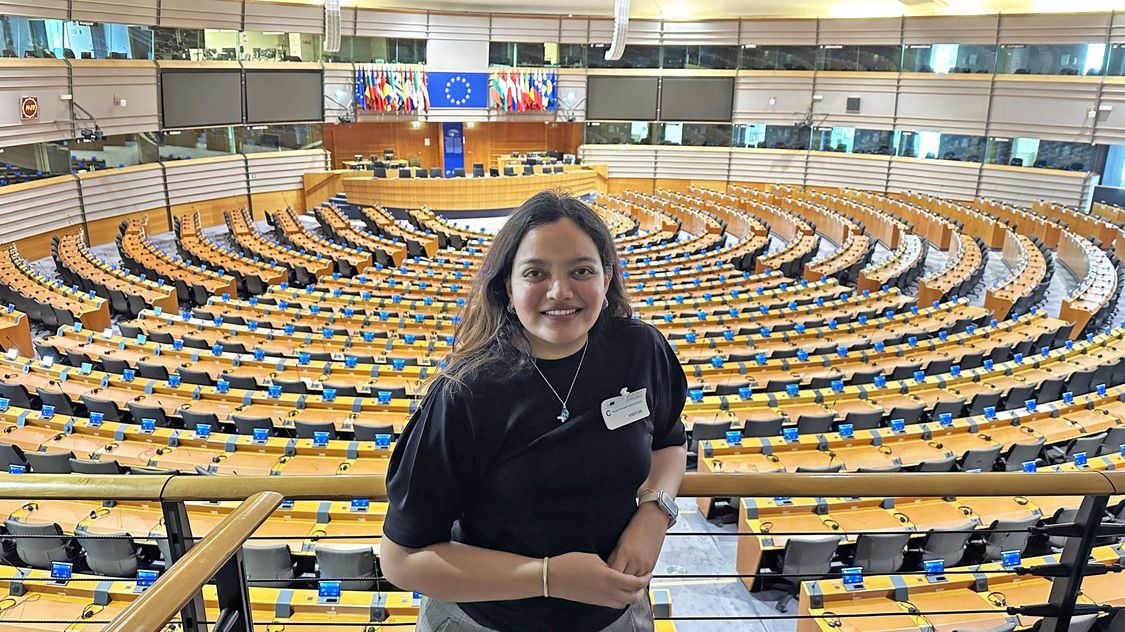
Participating in the InterGrad-EGD project feels like being welcomed into a large scientific family that shares the values of a sustainable future and the European Green Deal, a package of measures from the European Commission that aims to make Europe climate neutral by 2050. One of my highlights was the delegation trip to Brussels in the fall of 2025, organized in collaboration with the EU Academic Network of Saxony-Anhalt, which included a visit to the European Commission. But what motivated me most was the opportunity to connect my own doctoral thesis with an international research community and learn from different disciplines and perspectives. The InterGrad Campus events and the associated exchanges have been a very positive experience so far: seeing how other doctoral students present their projects, hearing the stories and “research minds” behind their ideas, and discussing our challenges and doubts together has inspired me to work even harder and more thoughtfully on my own dissertation.
What are your plans for the future after successfully completing your degree – both professionally and personally?
After completing my doctorate, I would like to broaden my field of activity and continue my academic career with a postdoctoral position in psychology, ideally at the interface between neuroscience and emotional intelligence. For me, psychology is an opportunity to learn to live more mindfully and understand other people's inner worlds, rather than just studying them from a distance. If I find a position that allows me to explore these topics in depth, I would be very grateful to be able to pursue this path. If not, I dream of building something of my own: a business based on business psychology, where I can create emotionally secure and supportive relationships. In both cases, my professional and personal goal is the same: to use knowledge and empathy to make people's lives a little easier, more understandable, and more connected.
You are very determined in your plans for the future, and your decision to leave your country to pursue a career in Germany was very courageous. Do you have any advice for young people who are still unsure about how they want to shape their lives?
I still remember the day I decided to apply to Harz University of Applied Sciences. And the day I quit my secure job in India. I was very afraid, especially when I was sitting on the plane to Germany and wondering if I was making a big mistake. But at some point, you have to take a small step forward, overcome your fear, feel everything fully, and only then will you slowly find out how to move forward. That's exactly what happened to me, and I promised myself to say “yes” to almost every opportunity, whether social or academic, in order to grow and gain new perspectives. To young people who are unsure about their path, I would say: don't wait until you're no longer afraid, and don't stop trying. Stay curious, try things out, and allow yourself to change direction if necessary – because you only have this one life to figure out who you want to become.
09.01.2026
Author: Karoline Klimek
Image author: © Sarah Stika, IHK Magdeburg
Image rights: © Harz University
