

Reflecting on the Transatlantic Summer School
Detroit is the beating heart of the automotive industry in the United States, and may not quite fit the definition of “sustainability” at first glance. However, a closer look reveals a city in the midst of structural transformation, and where a wide range of projects are seeking to make life in the city more sustainable. It was here, at Wayne State University, where the fourth Transatlantic Summer School on the topic of “Sustainability in the Comeback City” was held. Students and instructors from the host university, Harz University of Applied Sciences, Hochschule Ruhr West and Iowa State University came together to work on sustainable projects over a period of two weeks. This was preceded by a two-month online preparation phase.
The Transatlantic Summer School offers students international experience in an accessible format, explains Dr Robert Nadler, lecturer of Social Sciences at Harz University of Applied Sciences, who was also present as a lecturer in Detroit. “A semester abroad is not included in every degree programme, so students often lack the time for it. The relatively short Summer School gives every participant the chance to gain 14 days of compact, international experience, make new connections and learn about global perspectives,” he says. Students received financial support from a PROMOS grant, itself funded by the Federal Ministry of Research, Technology and Space. Nadler and his project group developed a sustainability monitoring website for the Wayne State University campus. “There is this incredible feeling of self-efficacy in seeing the projects actually being implemented,” says Nadler. “The open project structure, in which the participants got to help shape the course from the very start, provided additional motivation.”
“Working in international and interdisciplinary teams very quickly created synergy effects,” adds Dr Patrick Rempel, lecturer of IT, Data and Information Security. “The strengths of heterogeneous teams from different fields were made clear. This can be a very rewarding experience for the students.” Rempel’s project group prepared an exhibition at the Charles H. Wright Museum for African American History on the major power failure in Detroit and Ohio in 2017. The result was a timeline of the event, supplemented with interviews.
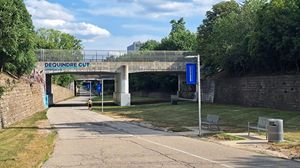
The Transatlantic Summer School was particularly special for Brian Kearney, English instructor at the Harz University of Applied Sciences Language Centre. Kearney, a Detroit native, was able to show his hometown from a personal perspective. “Helping the students get a feel for Detroit, for the challenges of recent decades and how some of those have been overcome, was an incredible experience. My project group created a website for the city government with background information on road signs that honour special individuals from Detroit’s past and present. Pedestrian and cycling paths that connect these signs were devised. The students made for a very strong team; and, just as importantly, they got insight into the processes that underlie urban development.”
“The Transatlantic Summer School was a success all around, giving students the opportunity to work on sustainability concepts and gain international experience,” adds Dr. Louisa Klemmer, Vice President for Academic and International Affairs at Harz University of Applied Sciences. “Although the four-year programme concluded with the visit to Detroit, we are currently working on new formats and aim to continue our relationships with our partner universities.”
Ten students from eight degree programmes in all three faculties at Harz University of Applied Sciences took part this year. Three of them share their experiences in an interview:
What did you like in particular about the Transatlantic Summer School?
Alternating between project work at Wayne State University and the trips! We got to better understand the country, the culture and the people. Our support from the partner university was also very well organised. We could always count on finding someone to talk to about any concerns or questions.
What did you learn about sustainability and what did you work on for the project?
I was able to learn more about the 17 Sustainable Development Goals of the United Nations and look at how these goals are being implemented in the United States.
The focus of the project that I helped work on was food waste and how it can be reduced. We were shown the possibilities of what can be achieved if enough volunteers come together who want to bring about change. For example, one morning we took part in the Upcycling Kitchen, where we helped prepare meals for people in need. This gave us a unique look behind the scenes of an initiative like that.
What did you think of Detroit and the USA?
Many expectations that I already had before my trip to the USA were quickly confirmed, like the widespread use of cars, Americans’ open personalities and the vastness of both the country and the city of Detroit itself. Detroiters love their city and are very proud of it and its successes in sports, music and other areas. It is a city with enormous potential and history, especially when it comes to the automotive industry.
What did you especially enjoy about the Transatlantic Summer School?
“How was Detroit?” This, of course, was one of the most common questions after I came back. I realise that I haven’t fully summarised my time there for myself, if that’s even possible. Good? Okay? Crazy? Maybe that wouldn’t do Detroit justice. The city fascinated and overwhelmed me with its ambiguity. I’m very thankful that I had the opportunity to take part in the 2026 Summer School and get to know Detroit over two weeks.
What did you learn about sustainability and what did you do during the project?
Sustainability lives in that space between personal commitment and the bigger picture, between ideal and reality. This involves learning how to reconcile your own contradictions. You learn to appreciate air conditioners (what can I say, they’re great). And it’s totally okay if I secretly want to take a pick-up truck on a road trip through the Midwest.
I was especially impressed by the local initiatives, which we encountered kind of randomly and were not part of our project at all. For example, the barkeeper at the brewery whose organisation builds and installs “benches” at bus stops. He uses recycled materials from demolished houses to make them. Small projects do extremely important work, often without pay, because the people behind them want to do it and they just take the leap. This do-it-yourself energy cannot be replaced by a top-down programme.
As a team, we developed, explored and walked three tours through Detroit. We researched the individuals behind the Secondary Street Signs, wrote and edited brief biographical texts. We learned a great deal about the people of Detroit who have been honoured with a street sign.
What did you like in particular about the Transatlantic Summer School?
All the variety between the group project work and the planned excursions and activities! I really enjoyed talking with students from other universities, too. We made a lot of new connections in two weeks and got to learn about different perspectives and experiences. This mixture of technical work, new impressions, and shared experiences made the Summer School really special for me.
What did you learn about sustainability? What did you work on during the project?
It became even clearer to me how multifaceted the topic of sustainability is, and that not every city or region will have the same solutions. Different locations will have their own challenges, requirements and opportunities for implementing sustainable projects. Because of this, it’s important to first work in accordance with the local conditions and develop suitable approaches based on them. In our project Secondary Street Signs, we created a way to discover Detroit in a way that is both sustainable and educational.
What did you think of the USA?
I was positively surprised by how open, friendly and helpful many people in Detroit were. I quickly got the sense that I was welcome, and it was easy to talk to all sorts of people. The two weeks there gave me a lot of new technical and cultural insight.
09.10.2026
Author: Mark Winter
Image author: © Nicole Coleman; Anneli Pagel; Sarah Peglow; Adrian Breuer; Brian Kearney
Image rights: © Harz University of Applied Sciences


